Mobile computing is one of those sticky subjects. Modern mobile computing runs around as cell phones and PDAs. Then there's the crazy people working on a "wearable comping" system that keeps them partially in a computer generated world at all times.
I'm not THAT crazy. I look more for something resembling military computing. There when you need it, mostly hidden when not. One thing that popped up recently is a tech outline of a wearable PC. See link here:
http://www.eurotech.it/main/news.asp?2M=75
Now, I've run across enough hardware to consider how to build one. A base board system would distribute controls as needed. The main CPU would be a Gumstix, with video breakout and some extra IO. I'm hoping they have a lot of breakout of the video and input hardware. This could be hooked into a 2.2" touchscreen TFT screen ($50 from Mouser). The base board also has built in audio connectors. A 400MHz Gumstix running Linux may be powerful enough to run a voice recognition software package, providing hands free access. A subsystem microcontroller would control stuff like LEDs, IO, touchscreen, etc. I'd probably integrate a pseudo-IMU so that motion may be used to do some control, such as a mouse. I might also wire in a glove or something to allow controlled clicking, or move the IMU to the back of the hand there (now there's an idea...)
Depending on size, a LION battery set can be hidden either behind the board or elsewhere (depending on ergonomics and design). Now, final design is that the casing could be made to look rather professional with a vac-formed casing.
Friday, June 30, 2006


Thursday, June 29, 2006
Optical Tracking Idea Update
Well, it's been a while. I was thinking again today about the optical tracking and how to reduce the need for speed. What did I come up with?
Take a CPLD and feed an IR filtered Kodak 580fps B&W camera into it. Use a microcontroller to clock the whole operation (I still think a dsPIC30/33 is a good choice). Within the CPLD, do a comparison on each IR pixel byte to a programed byte threshold fed in from the PIC. If matched or exceeded (whatever is easier), output to a latching port that feeds the dsPIC and trip an interrupt line. By feeding through the line and frame syncs, too, you can setup a signal delay match to the data line. Now, the big idea here is that the PIC keeps count on what pixel should be output (use a Timer module?) and records this and the value whenever the threshold is exceeded.
While a simpler system based around just passing a go/no go signal would work, I'd like to have the imaging data, too. This would allow some filters to be built that adjust the sensor threshold depending on brightness. Another technique could be used to determine if the data recieved is a false response due to reflection, etc. If you're using the ultimate output to just track a beacon like I'd do, you could use moving target filters to keep the area watched small.
The big advantage of this setup over a direct link is that you can significantly reduce the image processing requirements. Another one is that it's still fully possible to do full frame captures without any additional overhead or need to "switch off" a software comparison module.
A disadvantage of this method is that it tosses yet another IC onto a video board I am hoping to keep small.
Saturday, May 06, 2006
Base Ideas: Optical Tracking
Sometimes ideas just pop in. Here's one for a basic optical beacon tracker that can possibly operate over extended ranges.
An optical tube (possible zoom, definitely close to focused to "infinity") has an array of IR phototransitors/photodiodes at one end. The target has an IR beacon (IR transmitter, probably driven by a fixed rate PWM from a microcontroller). By either just tracking which transistors are on, or in a more advanced variant, how much energy each sensor "reads" from the target (or if too many see it), the direction that the assembly has to be turned can be calculated. Power levels help to determine the "zoom" of the optics (if fitted). The PWM'ed signal allows either a hardware or software filter to be constructed to look specifically for the PWM signal (similar to the carrier frequency used in IRDA)
An optical tube (possible zoom, definitely close to focused to "infinity") has an array of IR phototransitors/photodiodes at one end. The target has an IR beacon (IR transmitter, probably driven by a fixed rate PWM from a microcontroller). By either just tracking which transistors are on, or in a more advanced variant, how much energy each sensor "reads" from the target (or if too many see it), the direction that the assembly has to be turned can be calculated. Power levels help to determine the "zoom" of the optics (if fitted). The PWM'ed signal allows either a hardware or software filter to be constructed to look specifically for the PWM signal (similar to the carrier frequency used in IRDA)
Tuesday, April 25, 2006
Open Servo and Camera
I just can't get a good PCB made for that camera socket. The one time I had something going, my last socket self destructed. Just can't get back in the saddle on that one...
Now, while I think on how to attack that again, I ran across OpenServo. Nice system. They're working on their second generation based on a mid range Atmel chip. Actually, this is fairly close to what I was planning for the CAN network. I was going to rebuild a high power/speed servo with a custom controller board and provide full servo functionality. Still going to, but I'll be overkilling it with a dsPIC.
Speaking of CAN, I'm STILL trying to work on the software stack for that.
Wednesday, March 01, 2006
Camera: A Sense of Scale
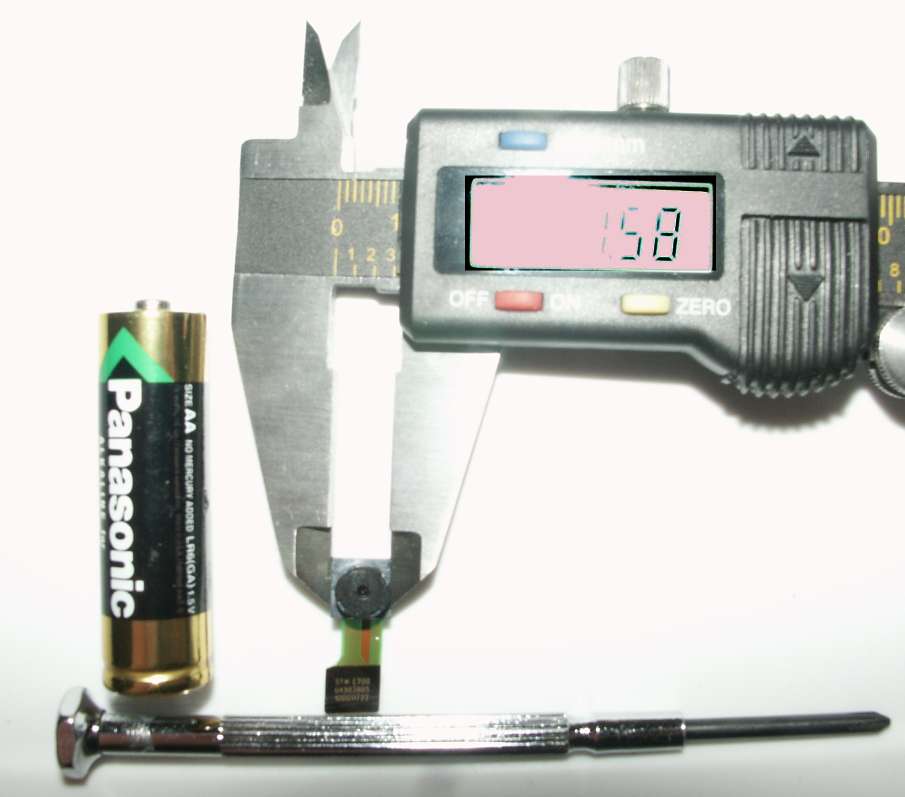
Well, I recieved my camera. I had issues getting a good picture of both the camera and the LCD. That is 7.58mm.
I really can't get a sense of scale until I have it in my hand. And that is TINY. The socket is about the size of a grain of rice and has a pitch of 0.4mm. That means 0.2mm of pad, and 0.2mm of space. That's roughly 8 mils each, about as fine as a normal hobbyist board house (say Sparkfun's BatchPCB ) will do. Scary.
Anyway, I'm planning on giving this one a try with home etching and soldering. I doubt I'll be able to get it without the mask, given the fine pitch, but who knows, it might work if I can figure out a mask or find out that a masking marker will work (temperature dependent).
Thursday, February 23, 2006
Sparkfun!
Sparkfun Electronics is a great site I've been poking around at for a long time. Just wish I could afford some of it.
Current wishlist that others might be interested in:
-Single transducer sonar unit with decent signal filtering onboard. Looks really nice.
-Various GPS units up the wazoo with lots of antenna options.
-Fully functional cell phone modules. Talk about tempting to build your own!
-Speaking of phones, they have a contest going on currently to figure out the hardware for their surplus, undocumented cameras from the Samsung E700.
-(I already have these) Affordable hot air rework and soldering stations. Quite useful
-accelerometers and gyros, ranging from single units to full IMU's. They are actually required to NOT sell the chips loose, but this is a decent way to get into the projects.
-Magnetic sensors for compass navigation.
I'm most interested in a small GPS module, a 3 axis mag sensor, and the sonar unit. That's about $170 worth of parts, so I'm afraid I have to hold off for a LONG while.
Subscribe to:
Posts (Atom)